Student Nameplates 2D Shapes Colors for Learning
In the dynamic environment of a classroom, particularly for young learners in first through third grade, the difference between confusion and clarity often comes down to accessibility. Student Nameplates 2D Shapes Colors are not merely decorative items; they represent a strategic approach to organizing learning spaces. By placing essential educational reference materials directly at a student's fingertips, educators and parents can transform a standard desk or pencil box into a functional learning hub. These editable student name tags bridge the gap between personal identity and academic tools, ensuring that critical information like the alphabet, number paths, and geometric shapes is always within reach.
The core value of these nameplates lies in their ability to reduce cognitive load. When a child does not need to search through a backpack or wait for teacher assistance to recall what a hexagon looks like or how to count to twenty, they can maintain their focus on the task at hand. This immediate access supports independent learning, allowing students to self-correct and build confidence as they work through math problems or spelling exercises. The design specifically targets the developmental needs of early elementary students by integrating visual aids with practical identification.
Optimizing Desk Space with Functional Design
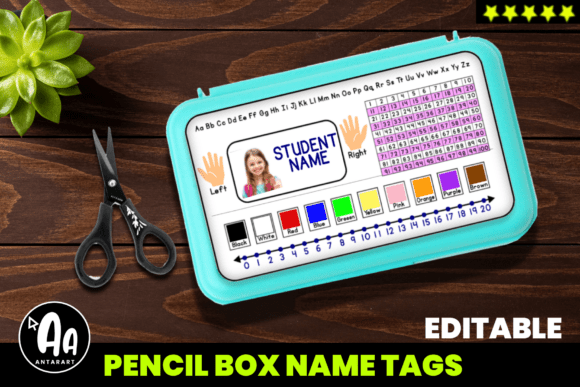
One of the most significant challenges in early education classrooms is managing limited physical space. Desks are often cluttered with supplies, and pencil boxes can become disorganized quickly. The Student Nameplates 2D Shapes Colors address this by offering a "gorgeous design" that fits seamlessly into various environments. Whether placed inside a pencil box, attached to a desk surface, or tucked into a cubby, the layout is engineered to maximize utility without taking up excessive room.
The inclusion of three specific sizes—large (7.25 x 4 inches), medium (6 x 3 inches), and small (4 x 2 inches)—ensures that every student has an appropriate tool for their specific workspace. A larger plate might be ideal for a dedicated desk area where a student spends the majority of the day, while a smaller version serves perfectly as a permanent fixture inside a pencil case. This versatility means that the same educational content can be adapted to different organizational systems, making it easier for teachers to implement consistent learning aids across the entire class.
Comprehensive Educational Content
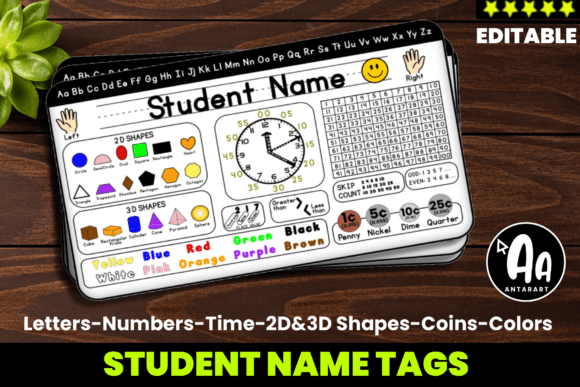
What sets these nameplates apart from standard identification labels is the depth of the educational content included on each tag. They function as multi-purpose reference sheets. Each tag features:
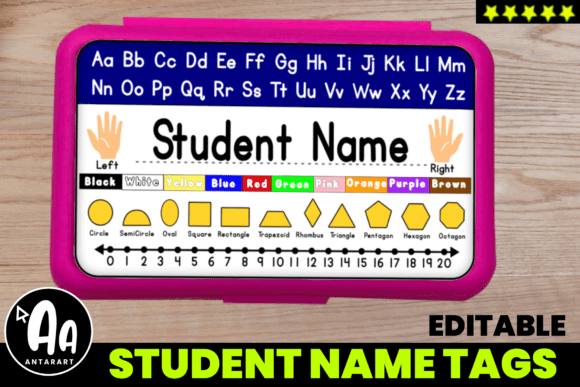
- The Full Alphabet: Providing immediate access to letter recognition, which is crucial for developing literacy skills.
- Number Path 1-20: A visual counting guide that helps students master sequencing and basic arithmetic concepts.
- 2D Shapes Chart: Detailed visuals and labels for circle, square, triangle, rectangle, hexagon, and other polygons. This visual reinforcement is vital for geometry introductions.
- Color Names: Clear labeling of colors to support vocabulary development and color recognition tasks.
- Hand Orientation Visuals: Distinct left and right hand graphics to assist students who struggle with directional awareness.
By consolidating all these elements into a single, personalized item, the nameplate becomes a constant study aid. Instead of having separate charts scattered around the room, the student carries their reference guide wherever they go. This continuity reinforces memory retention and provides a reliable touchstone during independent work sessions.
Customization and File Flexibility
For professionals such as teachers, homeschooling parents, and educational content creators, flexibility is key. The Student Nameplates 2D Shapes Colors offer robust customization options to meet diverse needs. Users can edit the files directly to insert student names, ensuring that the tool feels personal and relevant. This personalization fosters a sense of ownership and pride in one's workspace.
The availability of multiple file formats further enhances usability. The product includes PDF, PNG, JPG (all at 300 DPI), and SVG editable files. High-resolution images ensure crisp printing quality, whether using a home printer or a professional print shop. The SVG format is particularly valuable for those who wish to create custom-sized designs beyond the standard three options, allowing for precise adjustments to fit unique desk configurations or creative projects.
This level of technical adaptability supports a workflow that is both efficient and scalable. Educators can prepare materials weeks in advance, customize them for individual students, and then print them in bulk. The ability to reuse these tags by laminating them also adds a layer of cost-effectiveness and durability. Laminated plates withstand daily wear and tear, crayon marks, and spills, making them a sustainable investment for long-term classroom use.
Ideal Applications for Early Grades
While the primary target audience includes First, Second, and Third Grade students, the applications extend beyond simple identification. These nameplates are exceptionally effective in math centers, where quick access to shape names and number paths can accelerate problem-solving. In a setting where time is of the essence, removing the friction of looking up information allows students to engage more deeply with complex concepts.
Furthermore, the orientation visuals (left and right hands) serve a dual purpose. They assist in developing motor skills and spatial awareness, which are foundational for writing and reading. For students who are still mastering these concepts, having a visual reminder on their desk can prevent frustration and keep them engaged in the lesson rather than struggling with basic directional questions.
Practical Considerations and Implementation
When integrating Student Nameplates 2D Shapes Colors into a learning environment, it is important to consider the physical constraints of the space. While the large size offers ample room for information, it may not fit on every type of desk or inside every style of pencil box. Parents and teachers should measure their specific storage areas before selecting the large format. The medium and small sizes provide excellent alternatives for compact spaces, ensuring that the educational benefits are accessible regardless of the setup.
Additionally, while the digital files allow for extensive customization, users should be aware that editing requires specific software capabilities depending on the file type. For instance, editing the SVG or PDF files may require vector graphics software or specific PDF editors, whereas the PNG and JPG files are primarily for viewing or basic image manipulation. Ensuring that the necessary tools are available beforehand will streamline the preparation process.
The ease of printing and lamination makes these tags a practical solution for back-to-school preparations. They eliminate the need for expensive pre-made signage or time-consuming manual creation of reference charts. By utilizing these editable templates, educators can allocate more time to instructional planning and less to administrative tasks. The result is a classroom environment that feels organized, supportive, and conducive to learning.
In summary, these nameplates represent a thoughtful convergence of organization and education. They transform passive objects into active learning tools, providing students with the resources they need to succeed independently. Whether used to identify a desk, organize a pencil box, or support a math center, the Student Nameplates 2D Shapes Colors offer a versatile and effective solution for modern educational needs.