Transforming Classroom Functionality: The Strategic Value of Editable Pencil Box Name Tags
In the evolving landscape of modern education, the intersection of organizational efficiency and pedagogical support has never been more critical. For educators, administrators, and creators within the learning sector, the tools we introduce into the classroom environment do more than just organize supplies; they serve as foundational scaffolds for student development. Among these essential resources, Editable Pencil Box Name Tags have emerged as a pivotal asset, bridging the gap between personal identification and continuous academic reinforcement. These are not merely labels; they are dynamic, interactive learning stations that travel with the student, ensuring that helpful learning tools are always at their fingertips.
Redefining Student Workspace Utility
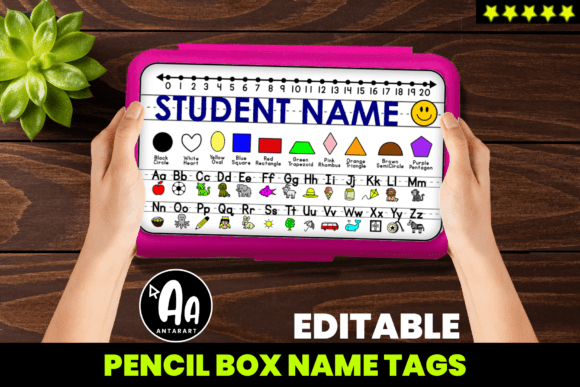
The traditional student desk or pencil box was often viewed solely as a storage unit for writing instruments. However, contemporary educational strategies emphasize the concept of "functional spaces." By integrating editable student name tags directly into these personal areas, teachers transform passive storage into active learning zones. This shift aligns with broader trends in instructional design where the environment itself becomes a teacher. When a student opens their pencil box, they are greeted not just by an eraser or a ruler, but by a curated interface containing the full alphabet, number paths, and geometric concepts.
This approach addresses a fundamental need in early childhood and elementary education: accessibility. Students in 1st, 2nd, and 3rd grades are in a critical developmental window where visual cues significantly accelerate cognitive processing. Having a reference chart permanently affixed to their workspace eliminates the friction of searching for information, allowing students to maintain focus on complex tasks like skip counting or shape recognition without breaking their workflow.
Bridging the Gap Between Personalization and Pedagogy
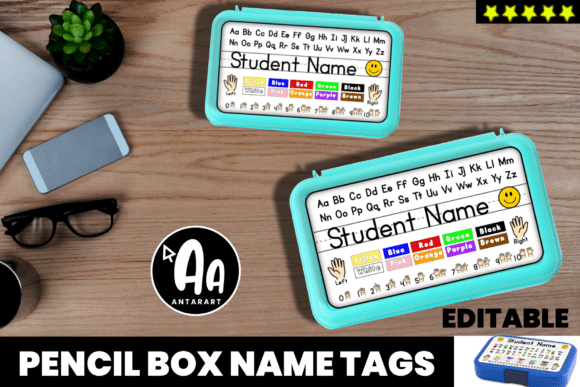
One of the most significant advantages of using Editable Pencil Box Name Tags is the seamless integration of personalization with standardized curriculum requirements. In a market increasingly driven by customization, the ability to customize personal size from the PDF or the editable file allows educators to tailor solutions to specific classroom layouts. Whether a student utilizes a large 7.25x4 inch tag for a spacious desk or a compact 4x2 inch version for a tight pencil box, the tool adapts to the user rather than forcing the user to adapt to the tool.
This flexibility is particularly relevant in the current educational climate, where diverse learning environments—from standard classrooms to hybrid learning setups—require versatile materials. The availability of three convenient sizes (large, medium, and small) ensures that the resource fits pencil boxes, desks, folders, or cubbies universally. Furthermore, the inclusion of color names and left/right hand visuals supports orientation and sensory processing, addressing the needs of neurodiverse learners who benefit from consistent, clear visual anchors.
A Comprehensive Toolkit for Early Math and Literacy
The content embedded within these tags represents a strategic condensation of core curriculum standards. Unlike static posters that remain fixed on a wall, these tags bring the curriculum to the individual level. The design features a comprehensive array of educational elements:
- Full Alphabet with Illustrations: This aids in phonemic awareness and letter recognition, providing immediate visual context for literacy skills.
- Number Path 1-20: Essential for early math skills, this helps students visualize numerical sequences and develop number sense.
- 1–100 Number Table: A robust tool for building number sense and supporting skip counting, a precursor to multiplication mastery.
- 2D Shapes Chart: Featuring circle, square, triangle, rectangle, hexagon, and others, this supports geometry basics and spatial reasoning.
- Color Names: Reinforcing vocabulary through association with visual examples.
- Hand Orientation Visuals: Left and right hand illustrations assist in developing body awareness and directional understanding.
By consolidating these elements into a single, portable format, educators create a self-sufficient learning ecosystem. This mirrors the efficiency seen in professional workflows where having necessary data points immediately available increases productivity and reduces cognitive load.
Adapting to Modern Workflow Expectations
The relevance of Editable Pencil Box Name Tags extends beyond the classroom walls into the realm of digital workflow efficiency. The demand for digital-first resources has surged, driven by the need for rapid deployment and sustainability. These tags are available in multiple file types including PDF, PNG, JPG, and SVG, all at 300 DPI for high-quality printing. This variety caters to different technological preferences and hardware capabilities within schools and home-school environments.
The "editable" nature of the product is perhaps its most transformative feature. In an era where agility is paramount, the ability to modify text fields before printing allows for instant updates. If a student transfers classes, changes seats, or if a teacher introduces new groupings, the tags can be updated instantly without the waste and cost of reprinting entire stock. This supports a sustainable approach to classroom management, reducing paper waste and encouraging the reuse of laminated materials. It reflects a growing consumer preference for products that offer longevity and adaptability over disposable, single-use items.
Strategic Implementation in Educational Settings
For professionals in the education sector, implementing these tags requires a shift in perspective regarding classroom organization. They are ideal for back-to-school preparations, setting up student desks, or organizing math centers. The ease of printing, laminating, and reusing makes them a cost-effective solution for budget-conscious institutions. Moreover, the durability of the final product ensures that the investment yields long-term value, serving as a constant reference point throughout the school year.
The forward-looking nature of this tool lies in its potential to foster independence. When students have immediate access to the alphabet, numbers, and shapes on their own property, they are empowered to solve problems autonomously. This reduction in dependency on the teacher for basic information allows educators to dedicate more time to higher-order instruction and individualized support. It is a practical application of the "scaffolding" theory, where support structures are gradually removed as competence grows, but in this case, the scaffold remains visible and accessible to guide the process.
Conclusion: A Necessary Evolution in Learning Tools
The introduction of Editable Pencil Box Name Tags represents more than a simple supply update; it is a strategic enhancement of the learning environment. By combining aesthetic appeal with rigorous educational content, these tags address the changing needs of students who require engaging, functional, and personalized tools to succeed. As the educational industry continues to prioritize student-centered design and efficient workflows, such innovative resources will play an increasingly vital role.
Whether for a 1st grader taking their first steps in math or a 3rd grader refining their geometry skills, these tags provide a reliable foundation. They exemplify how thoughtful design can bridge the gap between physical space and intellectual growth, making every square inch of a student's desk a potential hub for discovery. In a world that values customization, sustainability, and efficiency, these editable tags stand out as a testament to the power of practical, forward-thinking educational innovation.